Introduction
A ramp may exist and still be unsafe. Tactile paving may be installed and still be interrupted by obstacles. A handrail may look adequate at first glance while being loose, deteriorated, or poorly positioned.
Starting from this difference between simply existing and actually working, we developed the Building Diagnostics and Accessibility extension project in the Civil Engineering program at FUMEC University. The goal was to connect technical knowledge with everyday reality and show how inspection, diagnosis, and preventive maintenance contribute to safer, more accessible, and inclusive environments.
The work combined a literature review, study of technical standards, observation of accessibility features, production of educational material, a questionnaire, and an awareness initiative at SENAI Nova Lima. For me, it was also an opportunity to realize, even in the early semesters of my degree, that engineering begins before a solution is calculated: it begins with the ability to observe, interpret, and communicate a problem responsibly.
Building diagnostics beyond repairs
Building diagnostics investigates the condition of a building or its systems to identify defects and signs of deterioration, understand possible causes, and guide corrective or preventive measures. In practical terms, it helps answer four questions:
- What is happening?
- Why might the problem have occurred?
- What risk is associated with it?
- What type of technical action should be considered?
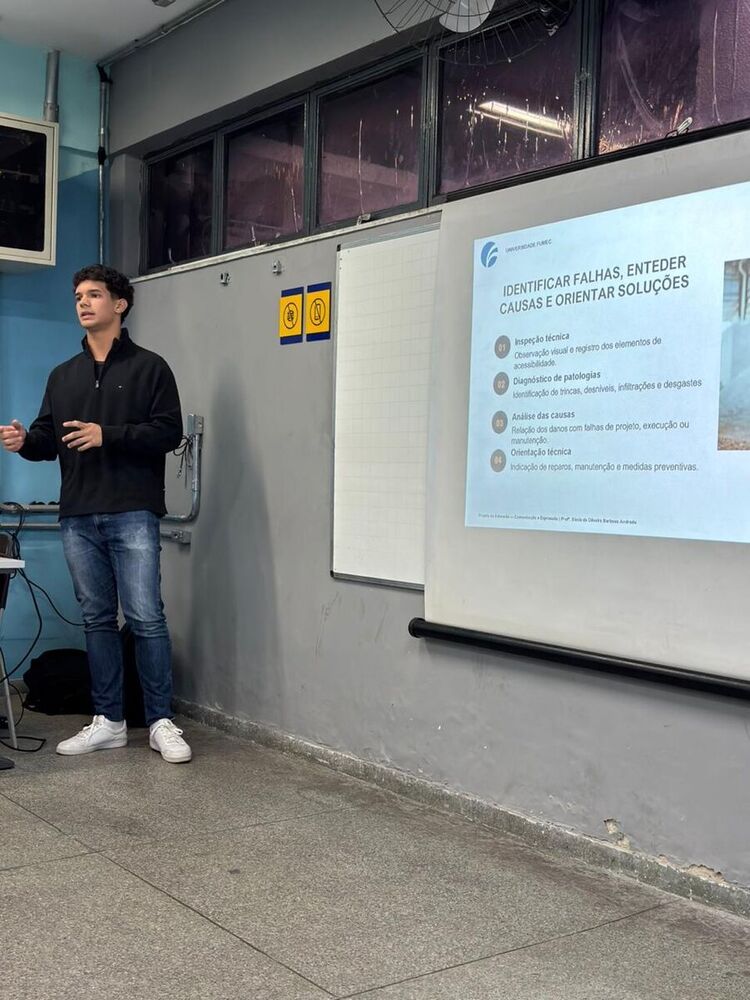
In the project, we organized this logic around four areas: technical inspection, identification of defects, cause analysis, and technical guidance. This approach avoids focusing only on visible signs. A crack, an uneven surface, or an unstable handrail is not merely an aesthetic imperfection; it may indicate failures in design, construction, use, or maintenance and directly affect the safety of people using the space.
Identifying failures, understanding causes, and guiding solutions: this was the principle behind the project.
Why place accessibility at the center?
Accessibility is not limited to the presence of a ramp or a sign. It depends on the integrated functioning of routes, flooring, slopes, handrails, stairs, signage, and circulation areas.
Our assessment therefore covered both construction-related issues such as cracks, wear, water infiltration, and uneven surfaces, as well as failures in installation, signage, and maintenance. The examples we studied included:
- ramps with inadequate slopes, cracks, or uneven surfaces;
- broken, irregular, or slippery floors;
- missing, damaged, discontinuous, or obstructed tactile paving;
- loose, deteriorated, missing, or improperly installed handrails;
- steps without signage;
- obstacles along routes that should remain clear.
These situations can reduce autonomy and increase the risk of accidents, especially for people with disabilities, older adults, pregnant people, and people with reduced mobility. Accessibility is not an afterthought in construction: it is a condition for safety, dignity, and appropriate use of space.
From research to action
We adopted an action research approach, combining technical study and educational activity. The process was organized into seven stages:
- a literature review on building diagnostics, defects, and accessibility;
- study of ABNT NBR 9050, NBR 16747, and NBR 15575;
- observation and photographic documentation of more than eight accessibility features;
- classification of issues by type, urgency, and impact on use;
- creation of a brochure, presentation, and digital resources in accessible language;
- administration of an online questionnaire;
- presentation of results to the school community.
The standards provided a basis for turning observations into criteria. ABNT NBR 9050 guided the assessment of accessibility features; NBR 16747 contributed building inspection principles; and NBR 15575 broadened the discussion of building performance.
Educational scope: we did not produce a professional report or a compliance certification. The purpose was to practice technical assessment of the built environment and communicate that knowledge to the school community.
More than compiling references, we needed to turn technical content into communication. The brochure summarized the concepts and benefits of early identification. The presentation organized the reasoning visually, while the project website expanded access with explanations, methodology, a checklist, a gallery, and references.
Meeting the students at SENAI Nova Lima
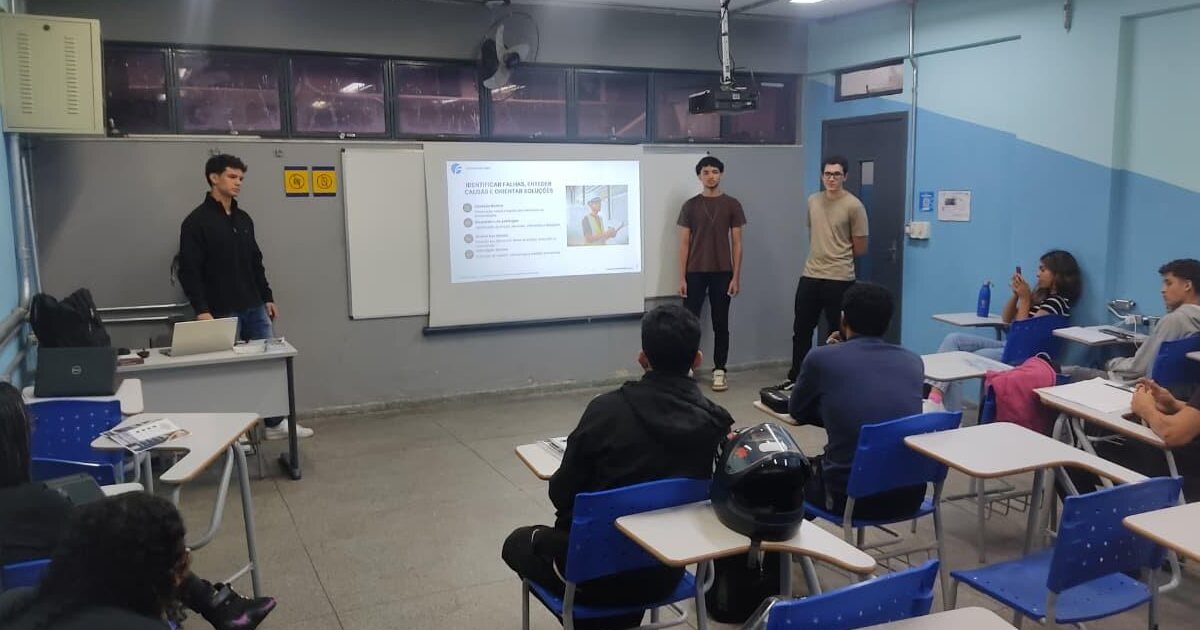
The project concluded on May 28, 2026, with a Results Seminar at SENAI Nova Lima. The team consisted of Bernardo Lopes, Emily Suelen, Guilherme Menezes, Gustavo Fanuchi, and Luis Fernando, under the guidance of Professor Sônia de Oliveira Barbosa Andrade.
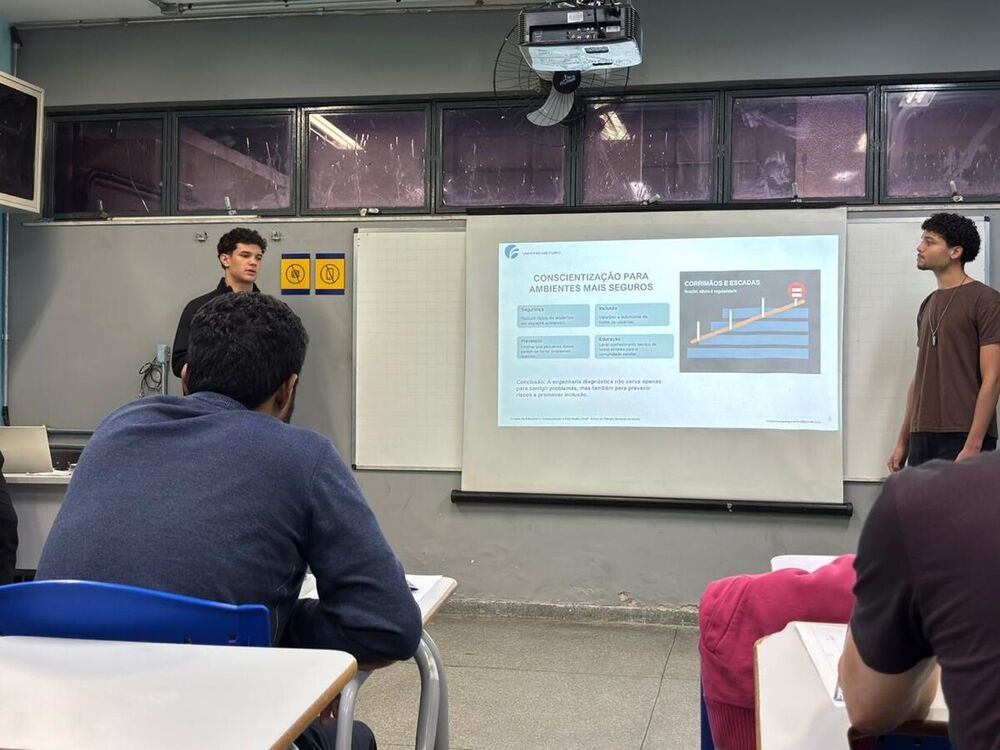
During the presentation, we explained how to recognize issues in ramps, flooring, handrails, stairs, and signage; discussed possible causes; and showed why periodic inspections and maintenance matter. The goal was not to create specialists in a single conversation, but to provide references so that problems often treated as normal could instead be recognized as matters of safety and inclusion.
The experience also required an essential skill for any engineer: adapting language to the audience without losing precision. Connecting concepts to visible everyday situations transformed an academic assignment into a real communication experience.

What 72 responses revealed
The online questionnaire received 72 responses. Among participants, 81.9% were enrolled in technical education, 9.7% in higher education, and 8.4% in other programs.
| Observed problem | Responses | Percentage |
|---|---|---|
| Loose or poorly installed handrail | 63 | 87.5% |
| Damaged or missing tactile paving | 60 | 83.3% |
| Excessively steep ramp | 58 | 80.6% |
| Broken or uneven flooring | 18 | 25.0% |
| Obstacles along the route | 15 | 20.8% |
| Steps without signage | 12 | 16.7% |
| Missing handrail | 11 | 15.3% |
| Had never observed problems | 1 | 1.4% |
Because the question allowed participants to select more than one option, the percentages should not be added together. They indicate how often each type of issue was recognized.
Another result stood out: 97.2% responded that these problems can cause accidents. The same percentage recognized that insufficient maintenance can harm people with disabilities or reduced mobility: 70.8% said it causes “some” harm and 26.4% “a lot.”
The analysis also revealed an important contrast: many participants recognized these issues in daily life, but had little in-depth familiarity with the term building diagnostics. This reinforced the value of the educational initiative.
Completed activities are not the same as proven impact
One of the most important lessons from analyzing extension projects was learning to separate what we did from what we could demonstrate as a result.
The activities included research, records, the questionnaire, and production of the brochure, website, and presentation. The immediate results were the 72 responses collected, the mapping of the most commonly recognized issues, and resources that made the subject easier to understand.
The data indicate strong recognition of the risks associated with insufficient maintenance and accessibility failures. However, by themselves they do not prove long-term behavioral change or physical correction of the problems. Evaluating those impacts would require follow-up, comparison before and after the initiative, and dialogue with those responsible for maintaining the spaces.
What this experience added to my education
The project connected Civil Engineering concepts with problems that are often seen but not analyzed. The main lessons I take from it include:
- Observe before proposing: an appropriate solution depends on correctly identifying the problem, its context, and possible causes.
- Communication is also engineering: technical standards and criteria must be explained clearly to different audiences.
- Working with data requires care: numbers help support conclusions, but must be interpreted within the method's limitations.
- Maintenance is part of accessibility: correct design is not enough; features must also be preserved.
- Engineering has a social responsibility: decisions about the built environment affect autonomy, safety, and participation.
I also learned about collaboration. Every stage, from researching and organizing data to creating materials, building the website, and presenting, depended on the team working together. The result was not only an academic product, but an exercise in shared responsibility.
Next steps
The project could continue with questionnaires before and after educational initiatives, a more diverse audience, simplified checklists for school communities, and follow-up on maintenance referrals.
The website remains available as a public record and reference resource. Anyone can learn about the methodology, explore the main types of issues, and find a message that summarizes the purpose of the entire project:
An accessible space is a space for everyone.
More than correcting problems after they appear, building diagnostics helps prevent risks. When applied to accessibility, it reinforces something essential: building and maintaining safe spaces is a concrete way to promote inclusion.
- Team
- Bernardo Lopes, Emily Suelen, Guilherme Menezes, Gustavo Fanuchi, and Luis Fernando
- Advisor
- Professor Sônia de Oliveira Barbosa Andrade
- Institutions
- FUMEC University and SENAI Nova Lima
- Course component
- Extension Education - Communication and Expression
- Date
- May 28, 2026
Technical references
- ABNT NBR 9050: Accessibility to buildings, furniture, spaces and urban equipment. Rio de Janeiro: ABNT, 2020.
- ABNT NBR 15575: Residential buildings - Performance. Rio de Janeiro: ABNT, 2013.
- ABNT NBR 16747: Building inspection - Guidelines, concepts, terminology and procedure. Rio de Janeiro: ABNT, 2020.
- HELENE, Paulo R. L. Manual for the repair, strengthening and protection of concrete structures. 2nd ed. São Paulo: Pini, 1992.
- THOMAZ, Ercio. Cracks in buildings: causes, prevention and recovery. São Paulo: Pini; IPT; EPUSP, 1989.
- TRIPP, David. Action research: a methodological introduction. Educação e Pesquisa, vol. 31, no. 3, 2005.
Frequently asked questions
What is building diagnostics?
It is the field that investigates the condition of buildings and construction systems to identify failures, signs of deterioration, possible causes, and corrective or preventive measures.
Which accessibility features were studied?
The project covered ramps, flooring, tactile paving, handrails, stairs, signage, and circulation routes, considering construction, installation, and maintenance problems.
What was the main questionnaire result?
Among the 72 responses, the most commonly recognized problems were loose or poorly installed handrails, damaged or missing tactile paving, and excessively steep ramps. In addition, 97.2% recognized the risk of accidents.
Did the project conduct a professional inspection?
No. The activity had academic and educational purposes. It does not replace an inspection, technical report, or formal assessment performed by a legally qualified professional.
You can also visit the full project website or return to the articles page to follow future posts.